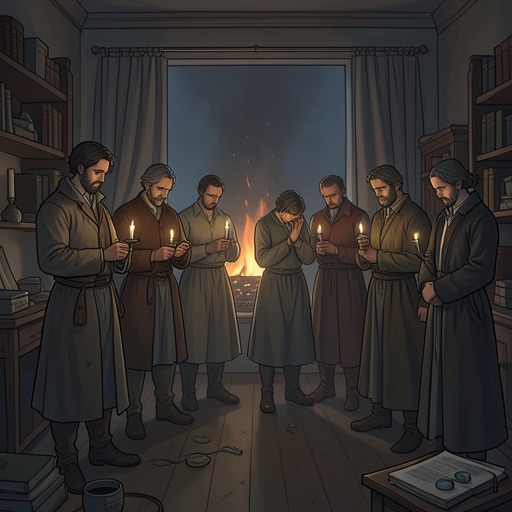
Church of Smyrna
Book of RevelationThe Church of Smyrna is one of the seven churches named in Revelation and addressed in the message John is told to send to the churches in Asia. Its passage sets material hardship and persecution against spiritual wealth, making steadfastness under suffering the congregation’s defining test. The promise to the faithful is not escape from trial but life beyond it.
Identity and Address
The Church of Smyrna appears in the seven-church commission alongside Ephesus, Pergamum, Thyatira, Sardis, Philadelphia, and Laodicea. The message is directed to the angel of the church, and its speaker identifies himself as the first and the last, who died and lives again. The congregation is thus addressed by a figure whose own passage through death frames the assurance offered to those who may face death themselves.
The church is recognized for its works and tribulation, as well as its poverty. The message nevertheless calls it rich: its standing is measured not by material circumstances but by fidelity amid hardship. This contrast establishes the central terms of the passage, in which apparent deprivation does not signify spiritual defeat.
Opposition and Trial
The message warns that some members will be imprisoned and tested, and that their tribulation will last ten days. It also speaks of people who claim to be Jews but are described in the text as belonging to a synagogue of Satan. This is the passage’s polemical characterization of the church’s opponents; the evidence gives no further account of the dispute or its circumstances.
The warning does not promise that the congregation will be spared suffering. Instead, it tells the church not to fear what it is about to endure and calls for faithfulness even to death. The defined period of ten days gives the forecasted trial a limit, while the possibility of imprisonment and death gives the appeal to endurance its weight.
Promise and Narrative Role
Those who remain faithful are promised the crown of life. The message also assures the one who overcomes that the second death will not harm them. These promises set bodily danger and ultimate spiritual consequence on different planes: death may be part of the trial, but it is not the final measure of the believer’s fate.
Within Revelation’s messages to the churches, Smyrna represents a community whose poverty and persecution are answered not with material reward in the present, but with recognition, a bounded trial, and hope beyond death. Its passage makes endurance—not security or worldly prosperity—the measure of victory.